

Minnesota First-Degree Murder Laws: Penalties and Defense Strategies

Minnesota first-degree murder laws carry the most serious penalty in the state’s criminal code: a mandatory life sentence. Not every life sentence works the same way.
Section 609.185 of the Minnesota Statutes sets that mandatory life term. A separate corrections law, Section 244.05, subdivision 4, decides whether release is ever possible.
Minnesota’s First-Degree Murder Statute, in Plain Terms
First-degree murder in Minnesota is a killing that was planned and intended, or a killing that happened under one of the other specific situations the statute lists. A conviction always carries a life sentence: the law states that a person who commits a listed act “shall be sentenced to imprisonment for life.”
Clause (a)(1) covers a death that was premeditated and intended, whether the person killed was the intended target or someone else. Other clauses cover deaths during certain forcible sex offenses or listed felonies. They also cover the killing of a peace officer or other official on duty, a death that follows a pattern of abuse, and a death tied to terrorism.
What Does Premeditation Mean Under Minnesota Law?
Under Minnesota law, premeditation means the person thought about the act, planned or prepared for it, or decided to do it before acting. Section 609.18 gives that definition, and it names no minimum amount of planning time.
Premeditation is also what separates first-degree murder from second-degree murder, since both charges rely on this same definition.
What Is the Sentence for First-Degree Murder in Minnesota?
Every first-degree murder conviction in Minnesota carries a life sentence. Only some of those sentences rule out release for the rest of the person’s life. Which track applies depends on two laws: the heinous crimes statute, Section 609.106, and the corrections law that governs release eligibility.
| Category | Sentence | Release eligibility |
| Heinous crime circumstances under Section 609.106, such as a killing during a kidnapping, or a previous heinous crime conviction | Life imprisonment without possibility of release | None at any point |
| First-degree murder under paragraph (a), clause (5) or (6), with no previous heinous crime conviction | Life imprisonment | Only after a 30-year minimum term |
Serving 30 years makes a person eligible to be considered for supervised release, but eligibility is not release. Sources that say the charge always means life without the possibility of release miss the 30-year minimum that applies to this second track.
First-Degree vs. Second-Degree Murder in Minnesota
First-degree murder requires premeditation and carries a mandatory life sentence. Second-degree murder carries a maximum of 40 years in prison.
Section 609.19 covers second-degree murder in two forms. One is an intentional killing without premeditation. The other is an unintentional death during certain other felonies.
Premeditation is what moves a case from that 40-year maximum to mandatory life. Both charges sit in the same family of homicide and violent crime charges in Minnesota.
Can a Person Under 18 Be Sentenced to Life in Minnesota?
Yes. A person who was under 18 at the time of the offense can still receive a life sentence in Minnesota. The court imposes life imprisonment, not life without the possibility of release, under Minnesota’s separate juvenile sentencing rule.
A minimum term must be served before supervised release can even be considered. For a single life sentence that is not stacked on top of another sentence involving a separate victim, that minimum is 15 years; stacking sentences together, or having multiple victims, can raise the minimum to 20 or 30 years. Section 244.05, subdivision 4b sets these terms.
What Defense Strategies Are Used in Minnesota First-Degree Murder Cases?
Defense work in a Minnesota first-degree murder case usually turns on three questions: whether the killing was premeditated, whether it was legally justified, and whether the person was criminally responsible at the time.
- Premeditation and intent: The state must prove a decision made before the act. Without that proof, the case fails the first-degree standard and drops to second-degree murder and its 40-year maximum.
- Justification: Section 609.065 allows a person to take a life on purpose only in narrow situations. The person must reasonably believe it is necessary to stop or prevent an offense that would cause great bodily harm or death to them or to someone else. The rule also covers preventing a felony in their own home.
- Criminal responsibility: Under Section 611.026, a person is excused from criminal liability only with proof of a defect of reason, meaning a mental condition that keeps a person from reasoning clearly. The proof must show the defect left them unable to know what they were doing, or unable to know it was wrong.
These three grounds are starting points the law allows, not predictions about how a case ends. Which one fits depends on the facts and the evidence.
Is There a Time Limit for Filing Murder Charges in Minnesota?
No. In Minnesota, a charge for any crime that caused a death can be filed at any time after the death. There is no deadline, whether the charge comes as a complaint or an indictment.
Section 628.26 sets that rule, so a death from decades ago can still be charged. A closed investigation is not the same as a resolved case. A late charge still follows the ordinary route a felony case moves through Minnesota’s courts.
Talk to a Minnesota First-Degree Murder Lawyer
Anyone under investigation for a homicide in Minnesota should talk with a lawyer before answering questions from investigators. Keeping paperwork, phone records, and messages together gives a lawyer more to work with.
Our team at Capitol City Law Group brings 50+ years of combined experience, and you can read about our attorney profiles. We offer a free case evaluation, so if someone in your family is under investigation or already charged under Minnesota first-degree murder laws, contact us or call 651-705-6311.
50+ Years Of Collective Experience
A Proven Track Record of Success
Trial-Tested, Zealous Legal Advocacy
Represent Cases At All Court Levels
Accomplished Trial Lawyers
Fields marked with an * are required
"*" indicates required fields
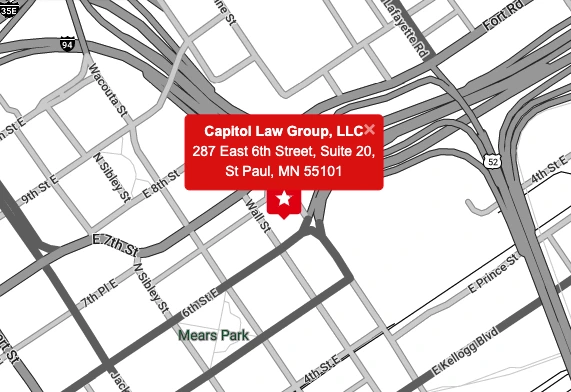


The Capitol City Law Group office is located in St. Paul, making it convenient to access attorneys in Minneapolis, St. Paul, and the Twin Cities metro area. We also serve the greater Minnesota area. We know that employment law and criminal defense concerns may require more immediate attention; please contact A.L. Brown, Marcus L. Almon, or Jennifer R. Congdon.
© 2026 Capitol City Law Group. All Rights Reserved.
