

Minnesota Juvenile Crimes Defense Lawyer
 If your child has been charged with a crime in Minnesota, the case usually starts in juvenile court, and what happens next can shape the next several years of their life. A Minnesota juvenile defense lawyer can help you understand which of three paths the case is likely to take: staying in juvenile court, moving forward as an extended jurisdiction juvenile case, or being certified to adult court.
Our team at Capitol City Law Group defends Minnesota children and teenagers on all three tracks, and we offer a free case evaluation to help your family understand what’s ahead. Call us at 651-705-6311, or contact us to talk through your child’s case.
Why Families Choose Capitol City Law Group for Juvenile Defense
Juvenile cases move fast, and the first decisions your family makes often matter more than anything that happens later. Our attorneys bring 50+ years of combined experience defending Minnesota clients, and we make it a priority to walk you through each stage of the process in plain language, from the first hearing through disposition or certification.
How Minnesota Juvenile Court Handles a Delinquency Case
 Minnesota juvenile court has original and exclusive jurisdiction over children accused of delinquent acts, which means it is the only court that can hear the case. If the act happened before your child turned 18, the case starts there and not in adult criminal court.
Minnesota law gives that jurisdiction to the juvenile court alone. What matters is your child’s age on the day of the act.
A delinquency case usually begins when a petition is filed by someone with knowledge of the alleged act, most often a law enforcement officer or probation agent, with the county attorney typically drafting and pursuing it from there. At the first hearing, the court addresses whether your child will admit or deny the petition, whether a lawyer needs to be appointed, and whether your child will be held or released while the case moves forward.
Two features surprise most parents:
- How the hearing runs: Without a jury, and the judge may proceed informally.
- How long it lasts: Generally to age 19, and to 21 in an extended jurisdiction juvenile case or if your child leaves a court-ordered placement without permission.
Does My Child Have a Right to a Lawyer in Juvenile Court?
 Yes. Your child has the right to effective assistance of counsel in a Minnesota juvenile court case.
The court must appoint a lawyer if the delinquency petition charges a gross misdemeanor or a felony, or if the state asks to place your child outside the home. Minnesota Statutes section 260B.163 gives that right to the child and to the parent, guardian, or custodian.
That right does not cover a juvenile petty offense as the statute defines it. The one exception is a third or later juvenile alcohol or controlled substance charge. Your child’s lawyer also cannot serve as guardian ad litem. That is the person a judge names to speak for a child’s interests.
How We Build a Defense for Your Child’s Case
 When a delinquency petition names your child, we look at every stage where the case could move in your family’s favor. That starts with the petition itself, whether it names an offense that actually fits the alleged conduct, and whether the evidence behind it holds up before your child ever answers to it in court.
If the state has filed or signaled a certification motion, we push back on the six factors a judge has to weigh, and we build the record that keeps a case in juvenile court instead of adult court. When a prosecutor designates a case for extended jurisdiction juvenile treatment, we work to negotiate the disposition terms so your child has a real path to close out the case without the adult sentence ever taking effect.
Every step, from the first hearing to a final disposition, is a chance to protect your child’s future, and we stay involved at each one.
When Can a Minnesota Teenager Be Certified as an Adult?
 A Minnesota juvenile court can certify a case to adult court, which moves it out of juvenile court, when the child was at least 14 at the time of an act that would be a felony for an adult. Certification is presumed when the child was 16 or 17 and the charge carries a presumptive prison sentence under Minnesota’s sentencing guidelines or involves a firearm.
When certification is presumed, your child must show why the case should stay in juvenile court. Both rules sit in Minnesota Statutes section 260B.125. If no presumption applies, the state must prove that keeping the case in juvenile court does not serve public safety, and the proof has to be clear and convincing. The court weighs six factors, giving the greatest weight to the first and third:
- The seriousness of the alleged offense
- Your child’s culpability in committing the offense
- Your child’s prior record of delinquency
- Your child’s programming history
- Whether juvenile-system punishment or programming is adequate for the offense
- What dispositional options are available for your child
A prosecutor does not have to win the certification motion to open the case to public view. Filing a certification motion opens your child’s electronic delinquency record to public access. That happens even where the case stays in juvenile court. We answer these motions in Minnesota juvenile court. You can read about our attorney profiles before you call.
What Is an Extended Jurisdiction Juvenile (EJJ) Prosecution?
 An extended jurisdiction juvenile prosecution is Minnesota’s middle track. The court hands down a juvenile disposition and an adult criminal sentence at the same time. It then stays the adult sentence, which means the sentence is on hold as long as your child follows the disposition order and commits no new offenses.
Minnesota Statutes section 260B.130 sets out three routes to the designation. A child aged 14 to 17 can be designated after a hearing. At 16 or 17, the prosecutor can designate the case in the petition.
If your child violates the disposition order, the court can hold a summary hearing, lift the stay, and treat your child as an adult. The prosecutor’s request also opens your child’s electronic delinquency record to public access under that same records statute.
| Stays in juvenile court | Extended jurisdiction juvenile | Certified to adult court | |
| Who is eligible | Any act before age 18 | 14 to 17 after a hearing; 16 or 17 by petition | 14 or older, felony allegation; presumed at 16 or 17 |
| What the court can order | Juvenile dispositions only | Juvenile disposition plus a stayed adult sentence | Adult sentence in adult court |
| How long authority lasts | Generally to 19 | To 21 | Adult sentence terms |
| Electronic record access | Shielded unless a trigger applies | Motion or request opens it | Motion opens it |
What Sentences Can a Judge Order in a Juvenile Case?
If the court finds a child delinquent in Minnesota, it orders whatever disposition it considers necessary to the child’s rehabilitation. A disposition is the juvenile court’s version of a sentence. Minnesota Statutes section 260B.198 lists the options:
- Counseling for the child or the parents
- Probation at home under court conditions
- Transfer of legal custody, if the child is a danger to self or others
- Commitment to the commissioner of corrections
- Restitution for damage to another person or their property
- A fine of up to $1,000
- Treatment for physical or mental health, provided by the parent or guardian
- A recommendation to cancel the driver’s license until age 18
The court picks the option that fits your child’s rehabilitation. The list is not ranked by how harsh each option is, so Minnesota juvenile probation sits beside commitment to corrections.
Are Minnesota Juvenile Records Public?
 Most Minnesota juvenile delinquency records are not open to public inspection, but there are real exceptions. One of them turns on your child being at least 16 years old at the time of a felony-level offense.
Minnesota Statutes section 260B.171 keeps juvenile court records closed. They open only by court order or where a statute requires disclosure. The same section treats police records of children who may be delinquent as private data.
Two exceptions attach early:
- Court records are open when the hearing itself is open. That same hearing statute opens the hearing where your child is 16 or older and the alleged act is felony-level.
- The public cannot look up electronic delinquency records, with three exceptions: the prosecutor filed a certification motion, the prosecutor designated or asked for an extended jurisdiction juvenile prosecution, or the court adjudicated your child delinquent of a crime of violence. Your child and the prosecutor can agree to keep the record closed.
What the prosecutor files can open the record, not only how the case ends. This is the same point made earlier in the certification section, from the other side: even a 16-year-old who is never certified can end up with an open hearing and a record anyone can pull. What can be done about that record later is a separate question, and clearing a juvenile record covers it.
Explore Our Minnesota Juvenile Defense Resources
 Each part of a juvenile case has its own rules, so we go deeper on the pieces families ask about most. Drug allegations are among the most common delinquency petitions, and our drug crimes defense page covers how those cases are built and answered, though the details can differ for a juvenile case. The adult system runs on different rules, and how a Minnesota criminal case moves through court sets them out.
FAQ: Answers for Minnesota Juvenile Defense
What Happens If My Child Misses Their First Juvenile Court Date?
Missing a scheduled court date in a juvenile case can lead to an arrest and, in more contested cases, added conditions before the case moves forward. It rarely resolves anything in your child’s favor, so contacting the court or your child’s lawyer immediately, before the date passes if possible, is important.
Can a Juvenile Record Affect My Child’s Ability to Get a Job or Into College Later?
Because many juvenile delinquency records are shielded from public view under Minnesota law, most records do not surface in a standard background check. But records that were opened through a certification motion or an adjudication for a crime of violence can be visible, which is one reason resolving a case without certification matters.
Will My Child Go to Jail While the Case Is Pending?
Not automatically. A judge decides whether to detain or release a child at the first hearing, based on factors like the offense, flight risk, and safety concerns, not simply because a petition was filed.
Talk to a Minnesota Juvenile Defense Lawyer
The earliest decisions in a juvenile case, such as how to answer a certification motion or how to respond to a delinquency petition, are the ones that shape everything after. It is worth getting advice before the first hearing.
Two things help right away. Keep the petition exactly as it arrived, and write down your child’s age on the date of the alleged offense.
If you’re looking for a Minnesota juvenile defense lawyer, we handle these cases from the first call through disposition at Capitol City Law Group. Call us at 651-705-6311, or contact us about your child’s case.
50+ Years Of Collective Experience
A Proven Track Record of Success
Trial-Tested, Zealous Legal Advocacy
Represent Cases At All Court Levels
Accomplished Trial Lawyers
Fields marked with an * are required
"*" indicates required fields
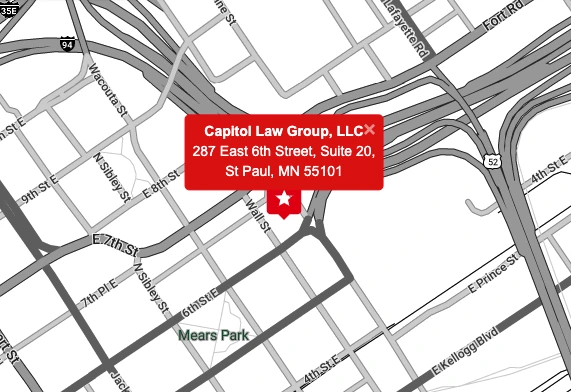


The Capitol City Law Group office is located in St. Paul, making it convenient to access attorneys in Minneapolis, St. Paul, and the Twin Cities metro area. We also serve the greater Minnesota area. We know that employment law and criminal defense concerns may require more immediate attention; please contact A.L. Brown, Marcus L. Almon, or Jennifer R. Congdon.
© 2026 Capitol City Law Group. All Rights Reserved.
