

What Is Disparate Treatment?

Disparate treatment is a common form of workplace discrimination that occurs when an employer intentionally treats an employee differently because of a protected characteristic such as race, sex, age, religion, disability, or national origin. If your employer has treated you differently because of your race, gender, age, or another protected characteristic, you may have a discrimination claim worth pursuing.
Disparate Treatment vs. Disparate Impact
These two terms sound similar, but they address different types of discrimination. Disparate treatment focuses on intentional discrimination, in which an employer knowingly bases decisions on a protected characteristic.
Disparate impact involves a policy that appears neutral but disproportionately affects a particular group. Under Title VII of the Civil Rights Act of 1964 and other federal and state anti-discrimination laws, both forms of discrimination are prohibited in the workplace.
Common Examples of Disparate Treatment
Disparate treatment can occur at nearly every stage of employment, from hiring to termination. You may not realize it is happening until you notice a pattern of unfair decisions affecting you or others with similar characteristics. Common examples include:
- Hiring bias: Passing over qualified candidates from a specific group in favor of less qualified applicants.
- Unequal discipline: Receiving harsher punishment for the same conduct that coworkers from a different demographic commit without consequence.
- Promotion denials: Being overlooked for advancement due to gender, age, or other protected traits.
- Compensation gaps: Earning less than coworkers who hold the same role and carry the same qualifications but belong to a different demographic group.
- Retaliation: An employer fires you shortly after you file a complaint about discriminatory behavior.
- Pregnancy discrimination: Your employer demotes you, reduces your hours, or forces you out of your position after learning you are pregnant.
- Hostile assignments: You are given undesirable tasks or shifts that colleagues in a different group never receive.
- Accommodation refusals: Granting religious accommodations to one group while denying the same accommodations to another.
Proving Disparate Treatment
Proving disparate treatment requires showing that your employer acted with discriminatory intent. Building a strong case starts with gathering the right evidence.
Establish a Prima Facie Case
The McDonnell Douglas framework, established by the U.S. Supreme Court, outlines the basic elements you need to demonstrate before the burden shifts to your employer. You must show the following:
- You belong to a protected class
- You were qualified for the position or were performing your job satisfactorily
- You suffered an adverse employment action
- Similarly situated employees outside your protected class were treated more favorably
Use Direct Evidence
Sometimes, the proof is straightforward because the discriminatory intent is right out in the open. Direct evidence removes the need for inference and points clearly to bias. Examples include:
- Emails or text messages containing discriminatory language
- Recorded statements from a supervisor referencing your protected characteristic
- Written policies that explicitly treat employees differently based on protected traits
- Testimony from witnesses who heard discriminatory remarks during decision-making
Use Circumstantial Evidence
Employers often do not leave a paper trail, so you may need to rely on patterns and context. Under the Minnesota Human Rights Act (MHRA), circumstantial evidence like the following can be just as powerful in establishing a discriminatory motive:
- A pattern of adverse actions affecting employees of a specific race, gender, or age group
- Inconsistent explanations from your employer about why they made a particular decision
- Timing that connects a protected activity, like filing a complaint, to a negative employment action
- Statistical data showing significant disparities in hiring, pay, or promotions
Document Everything
The strongest cases are built on detailed, consistent records that you start keeping as early as possible. Documentation with the following details creates a timeline that shows where discriminatory decisions occurred:
- Dates, times, and locations of discriminatory incidents
- Names of individuals involved and any witnesses present
- Copies of performance reviews, emails, and written communications
- Notes from conversations with supervisors or human resources representatives
Contact Our Employment Discrimination Lawyers
Are you dealing with unfair treatment at work that you believe stems from discrimination? You do not have to wait for the situation to get worse. At Capitol City Law Group, our attorneys have 50+ years of combined experience and are ready to listen and give you honest answers about your situation.
Contact us online to schedule a free consultation. Our employment discrimination attorneys can help you understand where you stand and what steps make sense moving forward.
We serve all areas in St. Paul and throughout Minnesota. Visit our criminal defense office at:
Capitol City Law Group, LLC
287 6th St E #20
St Paul, MN 55101
(651) 705-6311
Our firm is located near you. We have an office in St. Paul
Find us with our GeoCoordinates: 44.95119796512215, -93.08599954470851
50+ Years Of Collective Experience
A Proven Track Record of Success
Trial-Tested, Zealous Legal Advocacy
Represent Cases At All Court Levels
Accomplished Trial Lawyers
Fields marked with an * are required
"*" indicates required fields
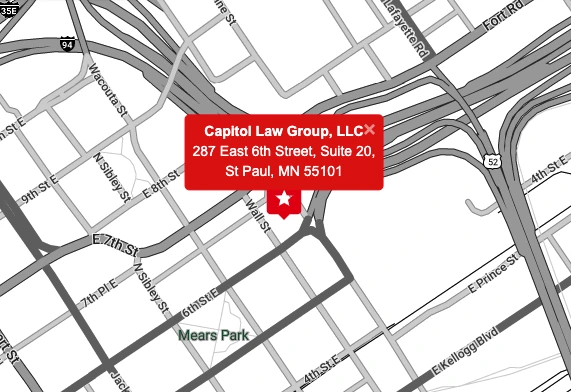


The Capitol City Law Group office is located in St. Paul, making it convenient to access attorneys in Minneapolis, St. Paul, and the Twin Cities metro area. We also serve the greater Minnesota area. We know that employment law and criminal defense concerns may require more immediate attention; please contact A.L. Brown, Marcus L. Almon, or Jennifer R. Congdon.
© 2026 Capitol City Law Group. All Rights Reserved.
