

Is Being Singled Out at Work Harassment?

When your supervisor consistently targets you with unfair criticism, assigns you undesirable tasks, or treats you differently from your coworkers, you may wonder whether this behavior constitutes illegal harassment. Being singled out at work can create a miserable professional experience, but not all unfair treatment rises to the level of actionable harassment under employment law. In most cases, being singled out is not illegal harassment unless it is tied to a protected characteristic or creates a legally hostile work environment.
If you believe you are harassed at work by a manager because of your race, gender, religion, disability, age, or other protected status, you may have legal recourse.
What Constitutes Workplace Harassment Under the Law?
Minnesota law prohibits workplace harassment based on protected characteristics, including race, color, national origin, creed, religion, sex, marital status, disability, public assistance status, age, sexual orientation, and familial status. The Minnesota Human Rights Act, Section 363A.08, makes it unlawful for employers to discriminate against employees based on protected classes.
For being singled out at work to qualify as illegal harassment, the treatment must connect to one of these protected characteristics rather than stem from general unfairness, personality conflicts, or poor management practices. Harassment becomes actionable when it creates a hostile work environment, severe or pervasive enough to alter your employment conditions.
Signs of Being Singled Out at Work
Recognizing the signs of being singled out at work helps you document problematic behavior and determine whether you face illegal discrimination. Common indicators that you may face targeted mistreatment include:
- Receiving harsher discipline than coworkers who commit similar infractions
- Getting assigned the most difficult or undesirable tasks while others receive preferential assignments
- Facing constant criticism while your colleagues receive praise for comparable work
- Being excluded from meetings, communications, or social events that include your peers
- Having your work scrutinized more closely than others performing similar duties
- Receiving unfavorable schedule changes or shift assignments without legitimate business reasons
- Getting passed over for promotions despite qualifications exceeding those of selected candidates
These patterns become legally significant when they correlate with your membership in a protected class. If your employer treats you differently because of a protected characteristic, that differential treatment may constitute discrimination or harassment.
Can I Sue for Being Singled Out at Work?
The question of whether you can sue for being singled out at work depends on the reasons behind your employer’s conduct. You may have grounds for legal action if:
- Your employer targets you because of a protected characteristic
- The mistreatment creates a hostile work environment
- You suffered adverse employment actions such as termination, demotion, or pay reduction
- Your employer retaliated against you for reporting discrimination or harassment
However, you typically cannot bring a lawsuit merely because a supervisor mistreats you, harbors personal dislike, or exercises poor management. Employment law does not forbid bad management nor guarantee fair treatment in every situation.
Taking Yourself Out of a Hostile Work Environment
Taking yourself out of a hostile work environment requires careful consideration of your legal rights and practical circumstances. Before resigning, you should take several critical steps:
- Document all incidents of harassment or discrimination with dates, times, witnesses, and specific details
- Report the conduct through your employer’s internal complaint procedures
- Preserve copies of relevant emails, messages, performance reviews, and other evidence
- Consult with an employment law attorney before making decisions that affect your legal rights
Leaving your job without adhering to proper procedures can restrict your legal options and weaken potential claims. In certain situations, constructive discharge claims allow employees to seek damages when unbearable working conditions effectively force resignation, though these claims must meet strict legal criteria.
How We Help Harassment Victims
Capitol City Law Group thoroughly evaluates workplace situations to determine the viability of legal claims and offers clear guidance on their potential strength. We support clients by:
- Gathering and preserving evidence supporting discrimination claims
- Filing complaints with the Equal Employment Opportunity Commission and the Minnesota Department of Human Rights
- Negotiating settlements that compensate victims for their losses
- Litigating cases in court when employers refuse to resolve matters fairly
We fight to hold employers accountable when they allow harassment to persist and help victims recover compensation for lost wages, emotional distress, and other damages.
Consult a Minnesota Hostile Work Environment Lawyer Now
If you experience being singled out at work and believe discrimination or harassment motivates your employer’s conduct, you deserve answers about your legal rights. Do not wait until the situation worsens or your employer retaliates against you for speaking up.
Contact our employment law lawyers at Capitol City Law Group to schedule a free consultation so we can evaluate your situation and explain your legal options.
We serve all areas in St. Paul and throughout Minnesota. Visit our criminal defense office at:
Capitol City Law Group, LLC
287 6th St E #20
St Paul, MN 55101
(651) 705-6311
Our firm is located near you. We have an office in St. Paul
Find us with our GeoCoordinates: 44.95119796512215, -93.08599954470851
50+ Years Of Collective Experience
A Proven Track Record of Success
Trial-Tested, Zealous Legal Advocacy
Represent Cases At All Court Levels
Accomplished Trial Lawyers
Fields marked with an * are required
"*" indicates required fields
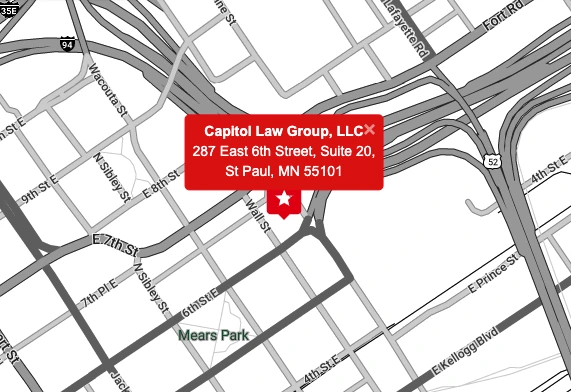


The Capitol City Law Group office is located in St. Paul, making it convenient to access attorneys in Minneapolis, St. Paul, and the Twin Cities metro area. We also serve the greater Minnesota area. We know that employment law and criminal defense concerns may require more immediate attention; please contact A.L. Brown, Marcus L. Almon, or Jennifer R. Congdon.
© 2026 Capitol City Law Group. All Rights Reserved.
