

Minneapolis Assault Lawyer
 After an assault arrest, the most important question is which of Minnesota’s five assault degrees the state charged, because the degree sets the most the court can impose, from 90 days in jail for a misdemeanor up to 20 years in prison for first-degree assault. Talking with a Minneapolis assault lawyer early helps you learn whether the evidence fits that degree.
Capitol City Law Group is a team of trial lawyers serving clients in Minneapolis, St. Paul, the Twin Cities metro area, and greater Minnesota. Call (651) 705-6311 or contact us to schedule a free consultation.
Why Choose Capitol City Law Group for an Assault Charge in Minneapolis?
 In an assault case, the gap between a misdemeanor and a felony can come down to how one injury is described in a medical record. At Capitol City Law Group, our defense strategy centers on challenging every piece of evidence the state brings.
Our team brings more than 50 years of combined experience and represents clients at every court level, including state, federal, and appeals courts. Our past results include serious felony charges that were reduced or dismissed.
What Counts as Assault in Minnesota?
 Under Section 609.02, subdivision 10 of the Minnesota Statutes, assault is either an act done with intent to cause fear in another person of immediate bodily harm or death, or intentionally causing or trying to cause bodily harm. The first branch needs no physical contact, so a threatening act can lead to an assault charge without any touching.
Minnesota’s criminal code also defines three levels of harm that separate one degree from the next:
- Bodily harm: This means physical pain or injury, illness, or any impairment of physical condition.
- Substantial bodily harm: This means a temporary but substantial disfigurement, a temporary but substantial loss or impairment of function in a body part or organ, or a fracture of any body part.
- Great bodily harm: This means an injury that creates a high probability of death or causes serious permanent disfigurement, a permanent or long-lasting loss of function, or other serious bodily harm.
A shove that hurts but leaves no mark can meet the lowest level. A broken finger can reach substantial bodily harm and turn the same incident into a felony.
The Five Degrees of Assault in Minnesota
Minnesota sorts assault into five degrees based on the injury, any weapon, and who the alleged victim was, with fifth-degree assault covering the rest. Each maximum below is a ceiling the statute sets, not a prediction of a sentence:
| Degree | What the state must prove | Highest penalty the statute allows |
|---|---|---|
| First, under Section 609.221 | An assault that causes great bodily harm | 20 years, a $30,000 fine, or both |
| Second, under Section 609.222 | An assault with a dangerous weapon | 7 years, a $14,000 fine, or both; 10 years, a $20,000 fine, or both if substantial bodily harm results |
| Third, under Section 609.223 | An assault that causes substantial bodily harm | 5 years, a $10,000 fine, or both |
| Fourth, under Section 609.2231 | An assault on someone the statute protects, such as an on-duty peace officer, firefighter, emergency room worker, or school official | A gross misdemeanor or a felony, depending on who was assaulted and the harm; injuring a peace officer, for example, allows up to 3 years, a $6,000 fine, or both |
| Fifth, under Section 609.224 | An act meant to cause fear of immediate harm, or causing or trying to cause bodily harm | A misdemeanor, with up to 90 days, a $1,000 fine, or both |
A weapon alone can make an assault a felony even when no one was seriously hurt.
Is Domestic Assault a Separate Charge in Minnesota?
 Yes. Under Section 609.2242, domestic assault uses the same two branches as fifth-degree assault, with one added element: the alleged victim is a family or household member.
Minnesota law defines that group broadly, from current and former spouses and relatives to people who live or have lived together, share a child, or are in a significant romantic or sexual relationship.A domestic assault starts as a misdemeanor, and a prior record raises it, as it does fifth-degree assault:
| Charge | With one qualifying prior | With two or more qualifying priors |
|---|---|---|
| Fifth-degree assault | Gross misdemeanor if the prior was within 10 years with the same victim, or within 3 years with any victim | Felony on the same 10-year and 3-year windows, counted from the first prior |
| Domestic assault | Gross misdemeanor if the prior was within 10 years | Felony if the first of the priors was within 10 years |
A gross misdemeanor allows up to 364 days, a $3,000 fine, or both, and the felony level up to 5 years, a $10,000 fine, or both. Qualifying priors are domestic violence-related crimes the law lists, such as assault or violating an order for protection, and juvenile adjudications (the juvenile court version of a conviction) count too. A domestic assault conviction also brings a three-year ban on possessing firearms, and a court can order a longer ban when a gun was used.
Under Section 609.2247, intentionally impeding a family or household member’s breathing or blood flow by pressing on the throat or neck, or by blocking the nose or mouth, is a felony even on a first offense with no visible injury, allowing up to 3 years, a $5,000 fine, or both.
Which Court Hears a Minneapolis Assault Case?
Assault charges from Minneapolis are heard in Hennepin County District Court (Minnesota’s Fourth Judicial District). The Minneapolis City Attorney’s Office prosecutes misdemeanors and gross misdemeanors committed in the city, while the Hennepin County Attorney’s Office prosecutes felonies and all juvenile cases. That means the charge level decides which office handles your case.
What Defenses Apply to a Minnesota Assault Charge?
Under Section 609.06, subdivision 1, reasonable force may be used against another person to resist an offense against the person or to help someone else resist one, including when someone reasonably believes those circumstances exist. That rule, which has exceptions, is the legal footing for self-defense, and we raise it whenever the facts support it. Beyond that, we look for where the state’s case is weakest:
- Intent: Both branches of the assault definition require intent, so we contest a charge built on an accidental contact or an unclear gesture.
- The level of harm: Whether an injury counts as substantial can separate a felony from a misdemeanor, so we test the medical evidence against the degree the state charged.
- The evidence: We compare body camera video, 911 calls, and witness accounts with the police report, since any of them can contradict it.
As trial lawyers, we know how to present these points to a jury if the case goes that far.
Questions About Assault Charges in Minneapolis
What Counts as a Dangerous Weapon in a Minnesota Assault Case?
More than guns and knives. Minnesota’s definition covers any firearm, loaded or not, and any object that, in the way it is used or meant to be used, is likely to cause death or great bodily harm. A bottle or a tool can qualify, so how an object was used can be a central question in a second-degree case.
How Long Can Someone Be Held After an Assault Arrest Before Seeing a Judge?
Under Rule 4.02 of the Minnesota Rules of Criminal Procedure, a person arrested without a warrant who is not released must see a judge without unnecessary delay and within 36 hours, not counting the day of arrest, Sundays, or legal holidays.
How Long Does the State Have to File an Assault Charge in Minnesota?
Generally three years from the date of the offense. That is the catch-all period under Section 628.26 of the Minnesota Statutes for crimes with no other set period, and time a person spends living outside Minnesota does not count toward it.
Talk to a Minneapolis Assault Lawyer at Capitol City Law Group
An assault charge can feel overwhelming, especially when the paperwork says felony. When you reach out, we explain your rights, your options, and what the state has to prove for the degree it charged. We also speak Spanish (hablamos español).
Call (651) 705-6311 or contact us today to schedule a free consultation with a Minneapolis assault lawyer at Capitol City Law Group.
50+ Years Of Collective Experience
A Proven Track Record of Success
Trial-Tested, Zealous Legal Advocacy
Represent Cases At All Court Levels
Accomplished Trial Lawyers
Fields marked with an * are required
"*" indicates required fields
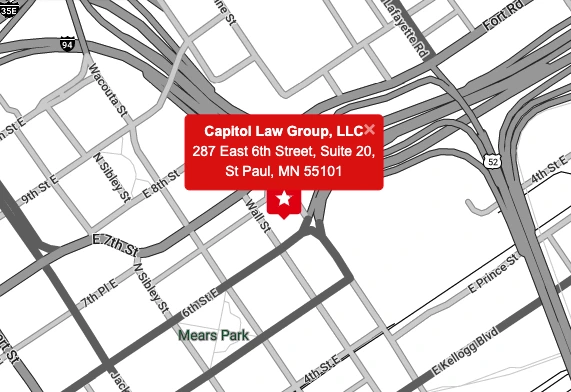


The Capitol City Law Group office is located in St. Paul, making it convenient to access attorneys in Minneapolis, St. Paul, and the Twin Cities metro area. We also serve the greater Minnesota area. We know that employment law and criminal defense concerns may require more immediate attention; please contact A.L. Brown, Marcus L. Almon, or Jennifer R. Congdon.
© 2026 Capitol City Law Group. All Rights Reserved.
