

Bail 101: How Does Bail Work?

Bail is a financial agreement between you and the court that allows you to leave jail while your criminal case moves forward. You pay a set amount or meet certain conditions. In return, the court releases you with the expectation that you will appear at every scheduled hearing.
How Does Bail Work in Minnesota?
Minnesota follows a structured process from the moment of arrest through the final resolution of your case. Each step carries its own rules and timelines, but here is how the process typically unfolds:
Arrest and Booking
After law enforcement places you under arrest, officers transport you to a local jail for booking. Staff record your personal information, take fingerprints and photographs, and document the charges against you. The process of setting bail may happen almost immediately if a preset bail schedule applies to your charge, or you may need to wait for a judge to review your case before any amount is determined.
Bail Hearing or Schedule
Minnesota Statute 629.53 allows for the release of arrestees on bail if the conditions warrant it. For less serious offenses, a bail schedule may already dictate the amount, and Statute § 629.471 sets limits for bail for suspected misdemeanor offenses.
For felonies or disputed situations, a judge will generally hold a hearing where both sides can argue for or against specific amounts. The judge considers different factors, discussed more below, before making a decision.
Posting Bail
Once the court sets your bail, you or someone on your behalf must pay the amount or arrange for a bond to secure your release. A criminal defense lawyer can help clarify which options make the most sense given your financial situation.
After posting, the court will outline your release conditions. Conditions may include travel restrictions, no-contact orders, or mandatory check-ins that you must follow carefully to stay out of jail.
Forfeiture or Release
If you attend every court date and follow all conditions, the court returns your bail money after the case concludes, minus any applicable fees. However, if you miss a hearing or violate your release terms, the court can revoke your bail and issue a warrant for your arrest. Under Minnesota Statute § 629.53, the court may also forfeit the entire bail amount, meaning you lose every dollar you posted.
Final Resolution
Your bail obligation concludes once your case is resolved, whether by dismissal, acquittal, a plea deal, or sentencing. Afterward, the court will either issue any refund due or apply the bail funds to outstanding fines and fees. Because refund timelines differ by county, it’s often wise to check with the court clerk to confirm when the money will be released.
Different Types of Bail
Minnesota courts have several options for handling your release. The type of bail a judge sets depends on the offense, your background, and the perceived level of risk you present. Not every case calls for the same approach, and the following options reflect the range of possibilities:
- Cash Bail: You pay the full bail amount in cash directly to the court, and the court holds the money until your case resolves.
- Surety Bond: A bail bondsman posts the full amount on your behalf in exchange for a non-refundable fee, typically around 10 percent of the total bail.
- Conditional Release: The court allows your release without requiring payment. However, it imposes certain conditions, such as electronic monitoring, drug testing, or regular check-ins.
- Release on Recognizance: A judge releases you based solely on your promise to appear, with no financial requirement attached.
Factors Considered When Setting Bail
Judges do not pull bail amounts out of thin air. Minnesota law requires them to evaluate specific factors that help determine whether someone is likely to appear in court and whether they pose a risk to the public. Courts typically consider the following when setting bail:
- The severity and nature of the charges
- Your prior criminal record
- Your employment status and community ties
- Whether you have a history of missing court dates
- The potential danger to victims or the public
- Your financial resources
- Any prior bail violations or failures to appear
Challenging Bail in Minnesota
If a judge sets bail at an amount you cannot afford, you have the right to request a review or reduction. Your attorney can file a motion asking the court to reconsider based on changed circumstances, new information, or an argument that the original amount was unreasonably high.
Courts must consider whether a lower amount or alternative conditions would still serve the purpose of securing your appearance and protecting the community. Judges also cannot set bail as a form of punishment before trial.
Don’t Wait to Contact a Minnesota Criminal Defense Attorney at Capitol City Law Group
When you or a loved one is sitting in jail waiting for answers, every hour feels like a lifetime. Capitol City Law Group brings over five decades of combined legal practice to every case we take on. You need someone in your corner who will work toward a fair outcome from day one. Contact us for a free consultation.
Contact our Criminal Defense Attorneys at Capitol City Law Group to schedule a free consultation so we can evaluate your situation and explain your legal options.
We serve all areas in St. Paul and throughout Minnesota. Visit our criminal defense office at:
Capitol City Law Group, LLC
287 6th St E #20
St Paul, MN 55101
Our firm is located near you. We have an office in St. Paul
Find us with our GeoCoordinates: 44.95119796512215, -93.08599954470851
50+ Years Of Collective Experience
A Proven Track Record of Success
Trial-Tested, Zealous Legal Advocacy
Represent Cases At All Court Levels
Accomplished Trial Lawyers
Fields marked with an * are required
"*" indicates required fields
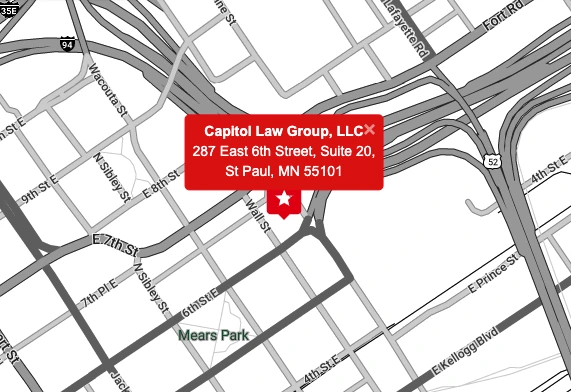


The Capitol City Law Group office is located in St. Paul, making it convenient to access attorneys in Minneapolis, St. Paul, and the Twin Cities metro area. We also serve the greater Minnesota area. We know that employment law and criminal defense concerns may require more immediate attention; please contact A.L. Brown, Marcus L. Almon, or Jennifer R. Congdon.
© 2026 Capitol City Law Group. All Rights Reserved.
