

St. Paul Sex Crimes Lawyer

Accusations of sexual misconduct are highly personal, with consequences that can impact your liberty, your reputation, and your long-term future. Whether the sex crime allegation involves a misunderstanding, a false report, or a misidentification, the way you respond in the first days matters. Without experienced guidance, you may overlook key opportunities to challenge the prosecution’s case or limit unnecessary risk.
Ramsey County prosecutors handle these cases with significant resources, often working alongside the St. Paul Police Department’s Family and Sexual Violence Unit and the Minnesota Bureau of Criminal Apprehension. Investigations move quickly, and statements made to officers without counsel present can shape the entire prosecution. Anyone contacted by law enforcement regarding an allegation should pause before answering questions and seek qualified representation immediately.
Capitol City Law Group represents people accused of sex crimes throughout the Twin Cities region. Call (651) 705-6311 or contact us online to schedule a free consultation with our St. Paul sex crimes lawyers, who will review the allegations privately and confidentially.
Why Clients Choose Capitol City Law Group

Our firm is built on courtroom results, which matters, as many sex crime cases go to trial. Our trial attorneys bring more than 50 years of combined experience and have argued matters at every level of the justice system, including state district court, federal court, the Minnesota Court of Appeals, and the U.S. Supreme Court when warranted.
Clients come to us when facing sex crime charges because we are respected, effective, and experienced. Our representation includes the following:
- Thorough pre-trial investigation
- Independent forensic review
- Negotiation backed by trial readiness
- Statewide and federal court admission
Capitol City Law Group has regularly obtained case dismissals and reduced charges for clients facing serious accusations. That track record reflects steady work, sound strategy, and our willingness to challenge the prosecution at every turn.
Types of Sex Crime Charges in Minnesota
In Minnesota, sex crimes are categorized by degrees based on the conduct alleged, the age of the parties, and whether force or coercion is claimed. Common sex crimes include sexual assault, rape, sexual exploitation, and child enticement. Degrees of sex crimes in Minnesota are as follows:
- First-Degree Criminal Sexual Conduct: The most serious classification, involving allegations of sexual penetration by force or threat of force combined with factors such as personal injury, use of a weapon, or a victim under 13.
- Second-Degree Criminal Sexual Conduct: Involves alleged sexual contact (without penetration) under aggravating circumstances similar to first-degree cases.
- Third-Degree Criminal Sexual Conduct: Penetration alleged under conditions such as a significant age difference or impaired capacity, without the aggravating factors of first-degree.
- Fourth-Degree Criminal Sexual Conduct: Sexual contact alleged under similar conditions as third-degree, but without penetration.
- Fifth-Degree Criminal Sexual Conduct: Nonconsensual sexual contact or lewd exposure, charged as a gross misdemeanor or felony depending on prior history.
- Indecent Exposure: Willful exposure of private parts in a public place, charged as a misdemeanor or gross misdemeanor depending on the circumstances.
- Possession of Child Pornography: Knowingly possessing prohibited images of minors.
- Solicitation of a Minor: Using electronic communication to solicit a person believed to be under 18.
The charging decision often depends on small details in police reports and digital records. Reviewing those documents early can reveal weaknesses the state hopes you will not notice. An attorney who has handled these cases in Ramsey County will know where to look.
What Are the Penalties for Sex Crimes in Minnesota?
Sentences for criminal sexual conduct in Minnesota are governed by the Minnesota Sentencing Guidelines and the statutory minimums set out in Minn. Stat. §§ 609.342–609.3451. Even a single conviction can have consequences that follow a person for decades. The penalties depend on the degree charged, prior record, and any aggravating circumstances proven at trial:
- Lengthy prison sentences: First-degree convictions are punishable by up to 30 years in state prison. The Minnesota Sentencing Guidelines establish a presumptive executed sentence of 144 months for many first-degree offenses, though mandatory minimums vary based on the circumstances of the offense.
- Significant fines: Felony convictions may result in fines of up to $40,000 in addition to incarceration.
- Mandatory sex offender registration: A conviction triggers registration under Minn. Stat. § 243.166, with mandated registry ranging from 10 years to life.
- Probation: Lengthy supervised release with strict conditions, including treatment programs and travel restrictions.
- Loss of civil rights: Forfeiture of civil rights, including the right to vote while incarcerated, possess firearms, and serve on a jury.
- Collateral consequences: Lasting damage to employment prospects, professional licensing, housing applications, and immigration status.
The Department of Corrections enforces conditional release terms strictly after a sentence is served. A small violation of registration rules can lead to new felony charges and additional prison time.
What Are the Different Levels of Sex Offenders?
Minnesota assigns convicted individuals a risk level after an end-of-confinement review by the Department of Corrections. The assignment reflects the likelihood of reoffense and determines how widely the public is notified about the person’s address and history:
- Level 1 offender: Lowest assessed risk of reoffense. Information is shared with law enforcement and, in limited cases, with people directly affected.
- Level 2 offender: Moderate assessed risk. Notification extends to schools, daycare centers, and community groups likely to encounter the individual.
- Level 3 offender: Highest assessed risk. Public notification through community meetings, online registries, and broad media announcements is standard.
Risk assignment can be challenged through administrative review when the assessment relies on incomplete or outdated information. Registration consequences can follow a person for years, making this stage of the process worth careful attention even after sentencing ends.
Proven Defense Strategies Against Sex Crime Charges in St. Paul
Every case turns on its own facts, and the defense must be tailored to the evidence the state has gathered. Below are several strategies our criminal defense attorneys regularly uses when preparing a response to charges filed in Ramsey County and surrounding jurisdictions.
Consent
When the accuser was a legal adult and capable of consenting, evidence of a willing encounter can defeat the prosecution’s theory. Text messages, social media exchanges, and witness accounts regularly support the defense and contradict the version offered to investigators.
False Accusations
False accusations occur more often than many people expect, especially in contested divorces, custody battles, or following personal conflicts. A thorough defense strategy looks for motive and inconsistencies in the accuser’s statements by reviewing:
- Prior statements
- Communication records
- Witness backgrounds
- Timeline contradictions
Inconsistencies in the evidence often expose fabricated claims. When credibility is the central issue, exposing a motive to lie can shift the entire direction of a case before trial.
Insufficient Evidence
Prosecutors must prove every element of the charge beyond a reasonable doubt. When physical evidence is missing, your accuser’s account is vague, or corroborating testimony does not exist, your case may not survive pre-trial motions or a jury trial.
Alibi and Mistaken Identity
If you were in a different location at the time of the alleged incident, records such as location data, surveillance video, and witness testimony may help confirm your whereabouts. Misidentification can also occur when the accuser has only brief contact with the individual involved, or when the report is made long after the alleged event.
Challenging Evidence and Witness Testimony
Cross-examination can expose inconsistencies, bias, and gaps in memory. Forensic evidence, such as DNA results, digital records, and medical exams, can also be reanalyzed by independent specialists to challenge the prosecution’s interpretation.
Motions to Suppress
If officers conducted an illegal search, took a confession without proper Miranda warnings, or violated procedural rules, the resulting evidence may be excluded. A successful suppression motion can gut the prosecution’s case and force a dismissal or favorable plea.
Frequently Asked Questions: Sex Crime Charges in St. Paul
What Is the Age of Consent in Minnesota?
The age of consent in Minnesota is 16. Sexual contact with anyone younger can result in criminal sexual conduct charges, even when the younger party agrees. Close-in-age provisions apply in limited circumstances, but they do not protect adults who are significantly older than the minor involved.
What Is the Statute of Limitations for Sex Crime Charges in Minnesota?
Minnesota expanded its time limits for criminal sexual conduct cases. Many felony-level offenses now have no statute of limitations, meaning charges can be brought decades after the alleged conduct, particularly when the accuser was a minor at the time.
Can the Accuser Drop Charges?
No. Once a complaint is filed, the decision belongs to the Ramsey County Attorney’s Office, not the accuser. A reluctant accuser may affect the strength of the case. However, prosecutors can proceed with other evidence even when the complaining witness wants the matter closed.
Are Polygraph Tests Admissible?
Polygraph results are not admissible in Minnesota courts as substantive evidence of guilt or innocence. Defense counsel sometimes uses private polygraphs as part of a negotiation strategy. However, the results cannot be presented to a jury under the current state evidentiary rules.
Contact Our St. Paul Sex Crimes Defense Team Now
Time matters when sex crime charges are filed. Investigators are gathering statements, prosecutors are reviewing reports, and the window for influencing the outcome narrows with each passing day. Do not wait to retain effective legal counsel. Our team at Capitol City Law Group is ready to step in immediately, examine the allegations, and protect what matters most.
Our firm provides skilled criminal defense representation across the Twin Cities and throughout the state. Call (651) 705-6311 or contact us online to schedule your free consultation with our St. Paul sex crimes lawyers, who will listen, advise, and act without delay.
50+ Years Of Collective Experience
A Proven Track Record of Success
Trial-Tested, Zealous Legal Advocacy
Represent Cases At All Court Levels
Accomplished Trial Lawyers
Fields marked with an * are required
"*" indicates required fields
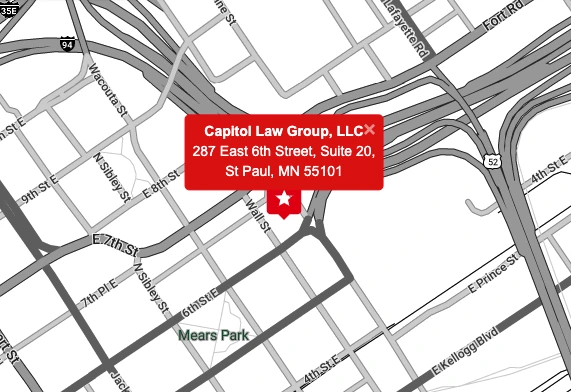


The Capitol City Law Group office is located in St. Paul, making it convenient to access attorneys in Minneapolis, St. Paul, and the Twin Cities metro area. We also serve the greater Minnesota area. We know that employment law and criminal defense concerns may require more immediate attention; please contact A.L. Brown, Marcus L. Almon, or Jennifer R. Congdon.
© 2026 Capitol City Law Group. All Rights Reserved.
