

St. Paul DWI Lawyer

Being arrested for driving while impaired (DWI) can be a shocking and disorienting experience. One moment you are on your way home, and the next you are dealing with handcuffs, a tow truck, and a court date that could affect your job, your license, and your reputation. The fear, confusion, and sleepless nights that follow are completely normal.
A DWI arrest is not the same as a conviction. Minnesota law gives you rights at every stage of the process, from the traffic stop to the chemical test to the hearing that follows. Taking careful, measured steps now, such as writing down everything you remember, avoiding any public statements about the incident, and requesting a hearing within the short window the state allows, can shape the outcome of your case significantly.
When you’re ready to talk through your situation, reach out to Capitol City Law Group. Call (651) 705-6311 for a free consultation, or contact us online to speak with our St. Paul DWI lawyers.
Why Choose a St. Paul DWI Lawyer at Capitol City Law Group?
With more than five decades of combined legal practice serving drivers throughout the St. Paul area, our attorneys are focused on protecting your rights and challenging DWI allegations with competent, courtroom-tested advocacy. Our trial attorneys have spent years working through the evidence the state brings in impaired driving cases, and we know where prosecutors look for weaknesses and how to counter them.
We support clients facing DWI allegations in the following ways:
- Reviewing body camera and dash camera footage frame by frame
- Filing motions to suppress improperly obtained evidence
- Cross-examining arresting officers and state chemists
- Negotiating with Ramsey County prosecutors for reduced charges
- Representing clients at implied consent hearings
- Pursuing dismissals when constitutional violations occurred
- Guiding clients through license reinstatement procedures
Across our criminal defense practice, we have secured dismissals, acquittals, and favorable plea agreements for clients facing first-time and repeat DWI charges throughout the St. Paul area and beyond.
Drunk Driving Laws in St. Paul
Minnesota makes it illegal to operate a motor vehicle with a blood alcohol concentration of 0.08 or higher, or while impaired by alcohol, a controlled substance, or an intoxicating substance. Minnesota Statutes § 169A.20 outlines the conduct that qualifies as driving while impaired and applies to drivers across the state.
Potential Penalties for a DWI in Minnesota
In Minnesota, DWI offenses are categorized into four degrees, depending on factors like prior convictions, blood alcohol content (BAC), and whether a child was in the vehicle. Each degree has its own set of potential jail time and financial penalties:
- Fourth-degree DWI: A misdemeanor carrying up to 90 days in jail and fines reaching $1,000.
- Third-degree DWI: A gross misdemeanor punishable by up to one year in jail and fines up to $3,000.
- Second-degree DWI: A gross misdemeanor with up to one year in jail, $3,000 in fines, and mandatory vehicle forfeiture.
- First-degree DWI: A felony carrying up to seven years in prison and fines as high as $14,000.
Aggravating factors, outlined in Minnesota Statutes § 169A.03, include prior impaired driving incidents within the past ten years, a BAC of 0.16 or more, or having a child under 16 in the vehicle. Each factor can push a charge up to the next degree.
Additional Consequences of a DWI in St. Paul
In addition to criminal penalties, a DWI arrest in Minnesota can result in administrative actions by the Department of Public Safety and affect many aspects of daily life. These consequences often start before your court appearance:
- License revocation: The state can revoke your driving privileges for 90 days to several years, depending on the circumstances.
- Vehicle plate impoundment: Plates may be seized and replaced with special “whiskey plates” on repeat or aggravated offenses.
- Ignition interlock requirement: Many drivers must install an ignition interlock device to regain driving privileges.
- Insurance rate increases: Auto insurers typically raise premiums significantly or drop coverage altogether.
- Employment consequences: Jobs requiring driving, professional licenses, or background checks may be at risk.
- Immigration impact: Non-citizens may face visa complications or removal proceedings.
Many of these administrative actions move on a faster timeline than the criminal case itself, which means deadlines can pass before a driver realizes what is at stake. For example, you only have 60 days to request a judicial review of your license revocation. Acting quickly preserves options that disappear if ignored.
Defending Against DWI Charges
Every DWI case is built on specific facts, and our attorneys build each defense strategy around the details of that particular arrest. We work through every report, recording, and test result to identify what the state can and cannot prove.
Unlawful Traffic Stop
Police officers must have reasonable, articulable suspicion that a traffic violation or crime has occurred before pulling a driver over. If the stop itself lacked legal justification, any evidence gathered afterward, including breath tests and field observations, may be thrown out of court entirely.
Expansion of the Stop
Even a lawful traffic stop has boundaries on its duration and scope. If officers extend a routine stop into a DWI investigation without sufficient evidence of impairment, that extension may violate the Fourth Amendment. This extension could lead to the suppression of any evidence of intoxication obtained afterward.
Challenging Field Sobriety Tests (FSTs)
Field sobriety tests (FSTs) are highly subjective and influenced by road conditions, footwear, medical issues, and nerves. Our trial attorneys have successfully challenged FST results in Ramsey County courts by highlighting officer training gaps, environmental factors, and the scientific limits of these roadside assessments.
Challenging Chemical Tests
Breath and blood tests are only as reliable as the equipment, training, and procedures behind them. Our St. Paul DWI attorneys scrutinize calibration records, maintenance logs, chain-of-custody documentation, and the qualifications of the personnel who conducted the test to expose errors that can undermine the state’s case.
Implied Consent Violation
Minnesota’s implied consent law requires officers to read a specific advisory before requesting a chemical test. If that advisory was skipped, rushed, or misstated, or if the driver was denied a reasonable opportunity to contact counsel, the test results may be subject to exclusion.
Rising Blood Alcohol Content (BAC)
Alcohol takes time to absorb into the bloodstream, so a driver’s BAC at the time of testing may be higher than it was behind the wheel. A rising BAC defense argues that the driver was actually below the legal limit while driving, even if the test later showed a number above 0.08.
Invalidating Test Results
Machines fail, samples get contaminated, and operators make mistakes. Our attorneys regularly consult with independent forensic experts to identify testing errors, protocol deviations, and scientific flaws that can render results unreliable and inadmissible in court.
Specific Minnesota Considerations for THC
Minnesota’s recent changes to cannabis laws have created new questions about how impaired driving is measured when THC is involved. Unlike alcohol, there is no per se THC limit, which means prosecutors must rely on observational evidence and chemical testing that raise unique challenges:
- No set threshold: Drivers can be charged based on officer observations rather than a specific THC blood level.
- Medical cannabis users: Registered patients still face DWI exposure if impairment is alleged.
- Metabolite detection: THC can remain in the body long after any impairing effects have worn off.
- Combination use: Mixing cannabis with even small amounts of alcohol can lead to aggravated situations.
Cannabis-related DWI cases rely heavily on subjective assessments and often turn on officer testimony and drug recognition evaluations, both of which can be challenged effectively with the right preparation.
FAQ: What to Know After a DWI Arrest in St. Paul
What Is the “Look-Back” Period?
Minnesota uses a ten-year look-back window when counting prior impaired driving incidents for enhancement purposes. Any qualifying prior within that timeframe, including alcohol-related license revocations, can elevate a new charge to a higher degree and trigger steeper mandatory penalties.
Should I Take the Field Sobriety Test?
Field sobriety tests are voluntary in Minnesota, and politely declining them is within your rights. Refusing these roadside exercises does not carry the same immediate consequences as refusing a chemical test after arrest, though officers may still make observations they later use as evidence.
Can I Get My Vehicle Back?
Vehicle forfeiture is possible in second-degree and first-degree DWI cases, but recovering a vehicle is often feasible through a timely forfeiture challenge. Strict deadlines apply, and missing them generally means losing the right to contest the seizure in Ramsey County court.
Can I Get My DWI Expunged?
Minnesota allows for the expungement of certain DWI convictions after a waiting period, though eligibility depends on the degree of the offense and the driver’s subsequent record. Our attorneys can review your history and help determine whether an expungement petition is a realistic path forward.
Protecting Your Future After a DWI Arrest in St. Paul
After a DWI arrest in Minnesota, deadlines start moving immediately. License revocation hearings must be requested without delay, evidence needs to be preserved quickly, and prosecutors begin building their case long before your first court appearance.
Reaching out to Capitol City Law Group sooner rather than later puts you in a better position to protect your driving privileges, your livelihood, and your record. Contact us at (651) 705-6311 or through our online form to schedule a free consultation with our St. Paul DWI lawyers today.
Visit Our Criminal Defense Law Office in St. Paul, MN.
50+ Years Of Collective Experience
A Proven Track Record of Success
Trial-Tested, Zealous Legal Advocacy
Represent Cases At All Court Levels
Accomplished Trial Lawyers
Fields marked with an * are required
"*" indicates required fields
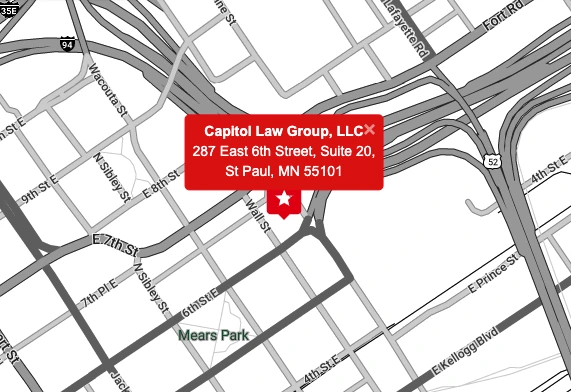


The Capitol City Law Group office is located in St. Paul, making it convenient to access attorneys in Minneapolis, St. Paul, and the Twin Cities metro area. We also serve the greater Minnesota area. We know that employment law and criminal defense concerns may require more immediate attention; please contact A.L. Brown, Marcus L. Almon, or Jennifer R. Congdon.
© 2026 Capitol City Law Group. All Rights Reserved.
