

Improper Time Rounding Practices in Minnesota

Are you a Minnesota worker who has realized that your employer has been trimming minutes from your timesheets through improper time rounding practices? What may appear to be small adjustments can quietly reduce recorded work hours, causing lost wages that accumulate into significant amounts over time. At Capitol City Law Group, our Minnesota wage and hour attorneys have seen firsthand how these small deductions create big problems for hardworking people.
You deserve to be paid for every minute you work. When an employer cuts corners with your time, that is not just unfair; it is illegal. You have options, and you do not have to confront your employer alone. We are here to help you hold them accountable and recover what belongs to you. Call (651) 705-6311 or contact us online to schedule a free consultation.
What Are the Legal Standards for Rounding?

Federal law under the Fair Labor Standards Act (FLSA), 29 C.F.R. § 785.48, allows employers to round employee time to the nearest five minutes, six minutes, or quarter hour, provided the rounding practice is neutral over time. In other words, rounding must be done so that employees are fully compensated for all hours worked. When rounding consistently favors the employer, it violates the Minnesota Fair Labor Standards Act (Minn. Stat. §§ 177.21–177.35), which requires payment for all hours worked.
What Is the “7-Minute Rule?”
The 7-minute rule is a common rounding method where employers round time to the nearest quarter hour. If you clock in within seven minutes of a quarter-hour mark, the time rounds down, and if you clock in past the seven-minute mark, it rounds up:
- Clocking in at 8:07 a.m. rounds down to 8:00 a.m.
- Clocking in at 8:08 a.m. rounds up to 8:15 a.m.
- Clocking out at 5:07 p.m. rounds down to 5:00 p.m.
- Clocking out at 5:08 p.m. rounds up to 5:15 p.m.
What Are the Indicators of Illegal Time Rounding?
Many wage and hour violations hide inside automated timekeeping systems and outdated payroll practices. If any of the following patterns show up at your workplace, you may have a valid wage theft claim:
- Systematic downward rounding: Your employer regularly rounds your clock-in time forward and your clock-out time backward, always in the company’s favor.
- Ignoring actual hours worked: Your timekeeping software does not capture the actual minutes you work, and management makes no effort to correct the issue.
- Ignoring overtime: Rounded hours remove time that would push you past the 40-hour federal or 48-hour state overtime threshold, effectively erasing overtime you earned.
- Automatic inactivity logouts: Your system logs you out after a period of perceived inactivity, even when you are still working away from your computer.
- Penalty deductions: Your employer rounds your time downward as a form of discipline for late arrivals, rather than addressing attendance through proper policy channels.
Even a few minutes lost per shift can add up to hundreds or thousands of dollars over a year. Workers who notice these patterns should begin documenting their actual hours immediately.
Employer Liability
Employers in Minnesota are responsible for maintaining accurate time records under Minn. Stat. § 177.30. When an employer uses a timekeeping system that consistently shortchanges workers, the employer cannot claim ignorance as a defense. The obligation to track and pay for every hour worked falls on the company, not the employee.
Legal and Financial Consequences of Improper Time Rounding
Employers that rely on improper time rounding practices may face significant liability under both state and federal law. Minnesota’s Wage Theft Prevention Act strengthened penalties and expanded enforcement powers, giving workers a greater ability to pursue and recover unpaid wages.
Wage Theft Claims and Penalties
Under Minnesota’s Wage Theft Prevention Act, wage theft can be prosecuted as a crime. Penalties can include fines and, in some cases, imprisonment.
Back Pay and Overtime Violations
Employees affected by improper rounding can pursue back pay for all unpaid hours. Common violations tied to rounding schemes include:
- Unpaid straight-time wages for rounded-down minutes
- Unpaid overtime pay owed when actual hours exceeded 40 per week under the FLSA
- Unpaid overtime pay owed when actual hours exceeded 48 per week under Minn. Stat. § 177.25, which applies to certain employers based on annual revenue. Larger employers are subject to the federal 40-hour threshold
- Liquidated damages equal to the amount of unpaid wages
Class Action Lawsuits
When an employer applies the same rounding policy across an entire workforce, a single claim can become a powerful class action. Our wage and hour class action lawyers have seen rounding violations affect dozens or even hundreds of employees at once, which may support:
- Collective actions under the FLSA for similarly situated workers
- Class actions under Minnesota state wage statutes
- Recovery of attorneys’ fees and litigation costs
- Court orders requiring the employer to fix its timekeeping practices
Administrative Audits and Fines
The Minnesota Department of Labor and Industry has authority under Minn. Stat. § 177.27 to investigate employers, audit payroll records, and issue compliance orders. Fines can reach $10,000 per violation for employers who fail to produce accurate records or who obstruct an investigation.
Retaliation Prohibitions
The law specifically prohibits employers from retaliating against workers who file wage complaints or assert their rights under the state’s labor statutes. Employers who violate these anti-retaliation protections face civil penalties, as well as liability for back pay and reinstatement.
How Capitol City Law Group Fights for Your Rights
With over 50 years of combined experience, our lawyers approach every wage theft case with a detailed, evidence-driven strategy built around your specific situation. We have the resources to pursue employers who shortchange their workers:
- Thorough payroll analysis: Examining your timekeeping records, pay stubs, and employer policies to identify every instance where rounding costs you money.
- Witness interviews and documentation: Gathering statements from coworkers and internal communications to understand how the rounding policy operates in practice.
- Demand and negotiation: Presenting your employer with a clear accounting of what they owe and pursuing a fair resolution before litigation becomes necessary.
- Effective litigation: When employers refuse to pay what they owe, our trial lawyers are prepared to take the fight to court on your behalf.
- Class action leadership: If the rounding violation affects multiple employees, we can build and lead a class action to recover wages for the entire group.
FAQ: Answers for Wage Theft Victims
Should I Keep Track of My Hours?
Absolutely. Keeping your own record of hours worked gives you strong support if a dispute arises. Use a notebook, a phone app, or even daily photos of the time clock to create a record that your employer cannot alter.
How Do I Prove Wage Theft?
Building a strong wage theft case depends on gathering documentation that shows a gap between the hours you actually worked and the hours your employer paid you for. Helpful evidence includes:
- Personal time logs with dates and exact clock-in and clock-out times
- Pay stubs showing fewer hours than you recorded
- Screenshots of your employer’s timekeeping software
- Copies of employee handbooks or policies describing the rounding method
- Statements from coworkers who experienced the same rounding patterns
Contact a Wage and Hour Lawyer at Capitol City Law Group
Are you losing money every pay period because your employer rounds your time in their favor? Our attorneys at Capitol City Law Group are ready to discuss your situation during a free consultation. Call (651) 705-6311 or contact us online to speak with a Minnesota wage and hour lawyer who will work to recover every dollar your employer owes you.
50+ Years Of Collective Experience
A Proven Track Record of Success
Trial-Tested, Zealous Legal Advocacy
Represent Cases At All Court Levels
Accomplished Trial Lawyers
Fields marked with an * are required
"*" indicates required fields
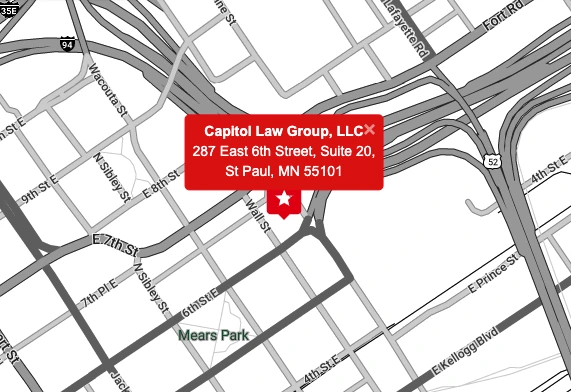


The Capitol City Law Group office is located in St. Paul, making it convenient to access attorneys in Minneapolis, St. Paul, and the Twin Cities metro area. We also serve the greater Minnesota area. We know that employment law and criminal defense concerns may require more immediate attention; please contact A.L. Brown, Marcus L. Almon, or Jennifer R. Congdon.
© 2026 Capitol City Law Group. All Rights Reserved.
