

St. Paul Employment Lawyer

Something likely felt wrong, whether your hours got cut, a promotion disappeared, or your paycheck came up short after you raised a concern at work. Capitol City Law Group has seen these patterns repeatedly in St. Paul workplaces, and we understand how unsettling it can be when your job suddenly stops adding up.
Minnesota law gives working people real protections against discrimination, retaliation, and unpaid wages. Our St. Paul employment lawyers help you figure out whether what happened to you crossed a legal line, and what your options look like from here.
Minnesota workers turn to Capitol City Law Group for direct guidance and free consultations. Call [phonenumber], or contact us online to share what happened at work today.
Why St. Paul Workers Choose Capitol City Law Group

Capitol City Law Group built its practice on candid advice and consistent follow-through rather than empty promises. Our lawyers bring more than 50 years of combined experience to Minnesota workplace disputes, and we focus on achieving real results instead of making the loudest demands.
Every case gets the same treatment: careful review of your pay records, your personnel file, and the timeline of events. We stay effective and thorough rather than combative, since clear documentation wins Minnesota employment cases more often than volume ever does.
What Does Minnesota Employment Law Actually Protect at Work?
Minnesota employment law covers more than the moment you get fired. It regulates how you get paid, how your schedule gets set, and how your employer responds when you raise a legitimate concern.
These protections apply whether you work in an office along West 7th Street, a warehouse near the Midway district, or a hospital downtown. We look at your specific facts first, then match them to the Minnesota statute or rule that fits your situation, the same first step our employment lawyers take with every new case.
What Counts as Workplace Discrimination in St. Paul?
When your employer treats you worse because of your race, sex, age, disability, or another protected trait, that’s workplace discrimination. It can show up in hiring, pay, discipline, or firing decisions.
Minnesota law spells this out under Minn. Stat. § 363A.08. You do not need to prove your employer meant to harm you, only that a protected trait played a role in the decision.
Sexual harassment is also a form of discrimination under this law, whether it involves unwanted advances, comments, or a hostile work environment. Situations that most often lead to a viable claim in St. Paul workplaces include the following:
- Unequal pay for the same role and experience level
- Repeated exclusion from promotions or key projects
- Derogatory comments tied to race, age, or disability
- A sudden negative review right after a protected leave request
- Termination shortly after disclosing a medical condition
Patterns matter more than a single bad day at work. Save emails, texts, and performance reviews as they happen, since a documented timeline often carries more weight with the Minnesota Department of Human Rights than memory alone, and it gives our St. Paul employment lawyer team a clearer starting point.
How Do You Know If You Faced Illegal Retaliation?
When your employer punishes you for exercising a legal right, like reporting harassment or refusing an unsafe task, you may have a case for workplace retaliation. It often looks completely different from the original complaint.
The Minnesota Whistleblower Act, codified at Minn. Stat. § 181.932, protects you when you report a suspected violation of law in good faith. Your employer cannot discipline, demote, or fire you for making that report, even if the underlying complaint turns out to be wrong.
Retaliation in Minnesota workplace complaints includes:
- A sudden schedule cut after reporting a safety concern
- Demotion within weeks of a harassment complaint
- Exclusion from meetings or projects after speaking up
- Negative performance reviews with no prior documented history
- Termination that follows closely behind protected activity
Retaliation lawsuits filed in the area typically proceed through the Ramsey County District Court.
Are You Owed Pay for On-Call Time in Minnesota?
Minnesota treats on-call time as paid work far more often than most employees realize. If your schedule keeps you tied closely to your job even during off hours, you may be owed wages you never received.
Our employment lawyers build class actions around exactly this issue for workers who were never paid for mandatory on-call hours. Minnesota regulators count several categories of time as compensable hours, even when you are not actively performing tasks:
- Time spent waiting for an assignment on the employer’s premises
- Mandatory training or onboarding sessions
- Closing or cleaning duties required after your shift ends
- On-call time when your movement is restricted to a short radius
- Travel between job sites during a scheduled shift
Employers sometimes treat on-call pay as optional or bury it inside a flat stipend that falls short of minimum wage. When that happens across an entire team, the underpayment can support a class action rather than a single individual claim.
What Are the Signs Your Termination Broke Minnesota Law?
Minnesota follows at-will employment, so your employer generally does not need a reason to let you go. That said, a termination becomes illegal the moment it violates a specific statute, an employment contract, or a broader public policy, such as firing someone for serving on a jury or filing a workers’ compensation claim.
Context tends to matter more than the stated reason on your separation paperwork. We look at what changed right before your termination, since a shift in treatment after a complaint often points to an unlawful motive rather than a genuine performance problem.
A handful of red flags tend to separate a lawful layoff from an unlawful termination under Minnesota law:
- Termination arriving days after a formal internal complaint
- A stated reason that contradicts your personnel file
- Replacement by someone outside your protected class, meaning a group defined by traits like race, sex, age, or disability
- Withheld commissions or final wages after your last day
- Pressure to sign a release before receiving your last paycheck
A short conversation with our team can tell you within minutes whether your situation warrants a deeper look.
Employment Law FAQ for St. Paul Workers
How Long Do You Have to File a Workplace Discrimination Claim in Minnesota?
You generally have one year from the date of the incident to file a charge with the Minnesota Department of Human Rights, or 300 days to file with the federal Equal Employment Opportunity Commission. Missing either deadline can end your claim regardless of how strong the underlying facts are.
Does Minnesota Law Require Severance Pay After a Layoff?
No, Minnesota law does not require employers to offer severance pay after a layoff unless a contract, offer letter, or employee handbook promises it. Once an employer does offer severance, the agreement usually asks you to waive certain legal claims, so reading the terms closely pays off before you sign anything.
Can You Still Get Unemployment Benefits After Getting Fired in Minnesota?
Yes, getting fired does not automatically disqualify you from unemployment benefits in Minnesota. The Minnesota Department of Employment and Economic Development only denies benefits when your employer proves you committed job-related misconduct under Minn. Stat. § 268.095.
Our St. Paul Employment Lawyers Can Review Your Case Today
You do not have to sort through Minnesota employment law alone, and you do not have to decide anything tonight. Free consultations with our St. Paul employment lawyers give you a clear next step, whether that means filing a charge, negotiating an exit, or simply understanding where you stand.
The sooner our team hears the details, the sooner you get real answers instead of guesswork. Call [phonenumber], or contact our firm online to reach Capitol City Law Group directly about what happened at your job.
50+ Years Of Collective Experience
A Proven Track Record of Success
Trial-Tested, Zealous Legal Advocacy
Represent Cases At All Court Levels
Accomplished Trial Lawyers
Fields marked with an * are required
"*" indicates required fields
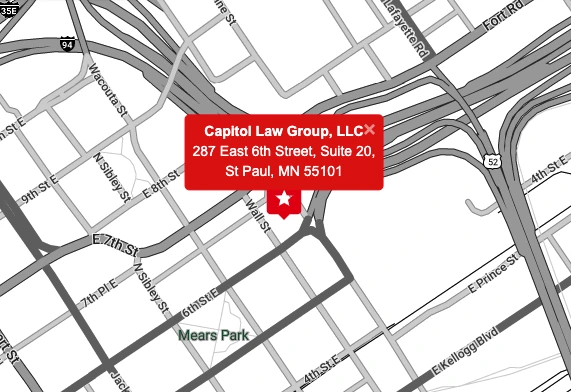


The Capitol City Law Group office is located in St. Paul, making it convenient to access attorneys in Minneapolis, St. Paul, and the Twin Cities metro area. We also serve the greater Minnesota area. We know that employment law and criminal defense concerns may require more immediate attention; please contact A.L. Brown, Marcus L. Almon, or Jennifer R. Congdon.
© 2026 Capitol City Law Group. All Rights Reserved.
