

St. Paul Assault Lawyer
 An assault charge can make one bad moment feel like it controls your whole future. A single accusation (often born from an argument that escalated) can put your job, your record, and your freedom on the line at once.
Right now, you may not know whether you face a misdemeanor or a felony, or what the police report actually claims happened. Getting clear answers early shapes everything that follows, and you have more room to act than it may feel like tonight.
With more than 50 years of combined experience, Capitol City Law Group has stood beside people across Ramsey County after an assault arrest. To weigh your legal options at no cost, contact us online or call (651) 705-6311 to schedule a free consultation with a St. Paul assault lawyer at our firm today.
Why Capitol City Law Group Belongs in Your Corner
 Facing an assault charge does not make you the person the police report describes. Our team starts by hearing your full side of the story, then tests whether the state can actually prove the version it put on paper.
Choosing the right lawyer early can change the direction of a case before it ever reaches trial. Our lawyers bring a strong background in criminal defense and seasoned advocacy in state and federal courts.
What you want is a team that treats your case like the only one that counts. Providing competent, effective representation means giving honest guidance about your actual choices, not making promises that no attorney can guarantee. Our St. Paul assault lawyers listen first, explain the law in plain terms, and build your defense strategy around the result you need most.
What Are the Degrees of Assault in Minnesota?
Minnesota sorts assault charges into five degrees, from a simple misdemeanor up to a serious felony. The degree of injury you face turns on how badly someone was hurt, whether a weapon was involved, and who the alleged victim happened to be.
First and Second Degree Assault
The most serious charges involve great bodily harm or a dangerous weapon. Under Minnesota Statutes § 609.221, first-degree assault carries up to 20 years in prison and a $30,000 fine, while second-degree assault involving a weapon can bring seven to ten years, depending on the harm caused.
Third and Fourth Degree Assault
Third-degree assault applies when an attack causes substantial bodily harm, and this felony carries up to five years in prison and a fine of up to $10,000. Fourth-degree assault usually involves protected victims, such as police officers or paramedics, and can be a gross misdemeanor or a felony depending on the facts.
Fifth Degree Assault
Most assault cases start here. Fifth-degree assault covers threats meant to cause fear of harm and minor physical contact, and it is a misdemeanor punishable by up to 90 days in jail and up to a $1,000 fine. A prior qualifying conviction can elevate it to a gross misdemeanor, carrying up to 364 days in jail.
The label on your charge is not the final word. A careful review of the evidence often shows a charge was overfiled, and a strong push early can move you down a degree or out of the system entirely.
Who Prosecutes Assault Charges in St. Paul?
Where your assault case lands depends on the degree charged, not just where it happened. In St. Paul, the same incident can be prosecuted by two separate offices:
- Misdemeanor and gross misdemeanor charges: The Saint Paul City Attorney’s Office handles fifth-degree and many fourth-degree cases.
- Felony-level charges: The Ramsey County Attorney’s Office prosecutes first-, second-, and third-degree assault.
- Your hearings: Ramsey County District Court, part of Minnesota’s Second Judicial District, are held at the courthouse on West Kellogg Boulevard.
The split matters because one early decision changes everything. A confrontation first treated as aggravated assault can sometimes be negotiated down, which moves your case off the county attorney’s felony track toward a far lighter result.
A felony or misdemeanor also affects your bail, your plea options, and your odds at trial. Getting in front of the right prosecutor with the right argument early is where an attorney wins or loses the most ground for you.
How Long Does an Assault Charge Stay on Your Record in Minnesota?
 An assault conviction stays on your criminal record permanently unless a court seals it through expungement. Even an arrest without a conviction can linger on background checks, which is why our assault lawyer looks at sealing options from day one.
Minnesota’s Clean Slate Act automatically seals many lower-level, nonviolent records after a crime-free waiting period. Because assault counts as a crime against a person, most assault convictions and related felony charges fall outside that automatic track.
To clear an assault record, you usually file a petition for expungement under Minnesota Statutes § 609A.02, and a judge weighs your interests against public safety. The Bureau of Criminal Apprehension (BCA) also keeps its own records, so sealing them takes a separate, careful request.
Waiting periods, eligibility, and timing all affect whether a petition succeeds. Sorting that out before you file gives you the best shot at a clean slate, rather than a denial that locks the record in place for even longer.
Employers, landlords, and licensing boards usually run background checks before they decide on you. A sealed record means most of them never see the charge at all, which can reopen doors that a conviction would have quietly closed.
What Defenses Work Against Assault Charges in St. Paul?
A charge is only an accusation, and several defenses can weaken or defeat it. The right approach depends on what the evidence actually shows, including body camera footage from the Saint Paul Police Department and what nearby witnesses remember. Defense strategies we may use include:
- Self-defense or defense of another person
- No intent to cause fear or bodily harm
- Mistaken identity in a chaotic or crowded scene
- An exaggerated or retaliatory accusation
Because violent crimes carry heavy penalties, building the defense early is what gives you leverage. Our St. Paul assault lawyers gather evidence while it is fresh and press prosecutors on weak points before the charges harden.
Witnesses move away, footage gets overwritten, and stories shift as the weeks pass. Locking down the facts now keeps your version of events intact while there is still time to put it to use.
Every assault case turns on small details, like who started the confrontation and what the injuries actually show. A close read of medical records and squad-car video can turn the state’s strongest point into the weakest part of its case.
St. Paul Assault Charges FAQ: What You Need to Know
Can You Be Charged With Assault If You Never Touched Anyone?
Yes. In Minnesota, assault includes acting with the intent to make someone fear immediate harm, even when no physical contact happens. Words by themselves rarely qualify, but a raised fist or a thrown object can be enough to support a fifth-degree charge.
Should You Talk to Saint Paul Police Before Getting Legal Advice?
No. You can politely decline to answer their questions and ask for counsel first. Officers may use what you say against you later, and our St. Paul assault attorneys would rather speak for you than spend the case cleaning up a recorded statement.
Will an Assault Conviction Affect Your Right to Own a Firearm?
Often, yes. Minnesota and federal law can strip firearm rights after certain assault or domestic assault convictions, sometimes for years and sometimes for life. The exact effect turns on the degree of the charge and whether the alleged victim was a family or household member.
Can a Domestic Assault Charge Be Dropped If the Other Person Recants?
Not automatically. The prosecutor, not the alleged victim, decides whether to pursue a case, and many press forward using 911 calls and photos even after someone recants. A recantation can still help your defense, so bring it up as early as you can.
What Happens at Your First Court Date After an Assault Arrest?
Your first appearance is usually an arraignment, where the judge reads the charges, sets bail or release conditions, and asks how you plead. Nothing about guilt is decided that day, so it is the moment to have counsel speaking for you rather than against you.
What Happens at a Preliminary Hearing for an Assault Charge in Minnesota?
A preliminary hearing is where a judge decides whether the state has enough evidence to move your case forward. The prosecutor has to show probable cause, and our attorneys can challenge weak evidence at this stage. A strong showing early can sometimes lead to reduced charges or dismissal before trial.
What Does the Trial Process Look Like for an Assault Case in St. Paul?
Most assault cases resolve before trial through negotiation, but if your case goes to trial, a prosecutor must prove every element of the charge beyond a reasonable doubt. Our attorneys cross-examine witnesses, challenge the state’s evidence, and present your defense to the jury. Ramsey County District Court handles felony trials, while misdemeanor cases are heard at the county level.
How Long Does It Take to Resolve an Assault Case in Ramsey County?
It depends on the charge. A misdemeanor fifth-degree case may resolve in a few months, while a felony charge can take a year or more from arrest to resolution. The timeline is shaped by how busy the courts are, whether a plea agreement is reached, and how much investigation your defense requires. Capitol City Law Group keeps you informed at every stage so nothing catches you off guard.
Get Ahead of Your Assault Charge
The hours after an assault arrest in St. Paul shape what comes next, and acting fast gives you the most room to protect your record and your freedom. Don’t leave your freedom up to chance. At Capitol City Law Group, our St. Paul assault lawyers know these courtrooms and the prosecutors who run them. To get started on your defense, schedule a free consultation with our team, contact us online, or call (651) 705-6311.
50+ Years Of Collective Experience
A Proven Track Record of Success
Trial-Tested, Zealous Legal Advocacy
Represent Cases At All Court Levels
Accomplished Trial Lawyers
Fields marked with an * are required
"*" indicates required fields
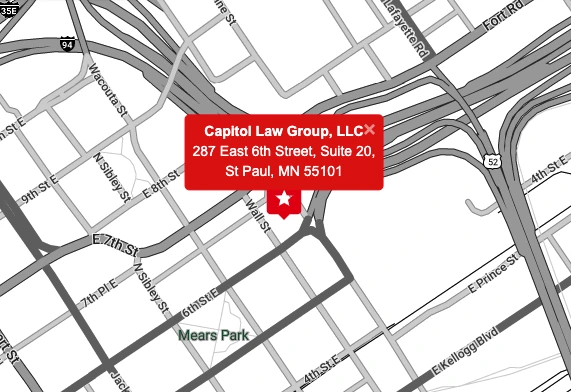


The Capitol City Law Group office is located in St. Paul, making it convenient to access attorneys in Minneapolis, St. Paul, and the Twin Cities metro area. We also serve the greater Minnesota area. We know that employment law and criminal defense concerns may require more immediate attention; please contact A.L. Brown, Marcus L. Almon, or Jennifer R. Congdon.
© 2026 Capitol City Law Group. All Rights Reserved.
